UK accused of 'collective punishment' over Sudanese students ban

When Ibrahim Dafallah checked his messages on Wednesday morning, he could hardly believe the news.
Nearly three years into Sudan’s devastating war, the country had been placed on a list of four nations whose citizens would be banned from obtaining visas to study in the United Kingdom, alongside Myanmar, Afghanistan and Cameroon.
For Dafallah, the announcement was devastating. The 23-year-old had just secured a place at the University of Oxford to study a master’s degree in health service improvement and evaluation and was preparing to begin his course in September.
The proposed ban was announced by UK Home Secretary Shabana Mahmood as part of a plan to curb cases where international students claim asylum after completing their degrees.
It comes amid a sweeping overhaul of asylum policy by the UK’s Labour government, under which asylum seekers would receive only temporary protection and face stricter rules on family reunification.
New MEE newsletter: Jerusalem Dispatch
Sign up to get the latest insights and analysis on Israel-Palestine, alongside Turkey Unpacked and other MEE newsletters
The visa restrictions target countries facing major internal conflict. Myanmar remains mired in a brutal civil war following the 2021 military coup, while Afghanistan has seen rising tensions and clashes along its border with Pakistan in recent weeks. Human rights monitors have raised serious concerns about abuses in all four countries.
In Sudan, the war has triggered one of the world’s worst humanitarian crises, displacing millions and leaving hundreds of thousands feared dead.
Both sides in the conflict, the Sudanese Armed Forces (SAF) and the Rapid Support Forces paramilitary (RSF), have been accused of committing atrocities. UN investigators said attacks on the city of el-Fasher by the RSF in October 2025 bore the “hallmarks of genocide”.
'We are very disappointed'
Dafallah was studying at Alzaiem Alazhari University in Khartoum when the Sudanese capital was captured by the RSF in April 2023, forcing him to flee a brutal urban battle for the city that lasted almost two years.
Nine months later, the town Dafallah fled to, al-Hilaliya, was also seized by the RSF, leaving him displaced for a second time. Meanwhile, his university in Khartoum faced months of closure.
Seventeen of Dafallah's family members have been killed during the conflict, including an uncle who was shot in the foot and later died after diabetes complications worsened the injury.
“I chose to study this master's because of the healthcare situation in Sudan,” Dafallah told Middle East Eye.
'We were hoping to get support on this via education abroad, so we are very disappointed'
- Ibrahim Dafallah, Sudanese student
“There are lots of issues with referrals and the quality of care that are systemic issues caused by the conflict,” he added.
“This master's focuses on teaching the skills to help tackle these issues.”
Dafallah returned to central Sudan after the Sudanese army took back control of the region in early 2025.
“People here are focused on trying to build back our country. We were hoping to get support on this via education abroad, so we are very disappointed,” he said.
In the 2024-25 school year, only 120 Sudanese students claimed asylum in the UK, representing less than half of those holding study visas, according to Home Office figures.
For Myanmar, the figure is even lower, with only 16 percent of those on student visas making asylum claims.
MEE contacted the UK Home Office for comment.
'Unprecedented' measures
The policy follows a similar move by the US President Donald Trump administration last month to ban nationals of 19 countries, including Sudan, from obtaining student and other short-term visas.
The UK Council for International Student Affairs, a charity representing international students, described the measure as “unprecedented” in the UK.
Dr Abeer Abdoon, a Sudanese academic, is also facing the prospect of giving up her hopes of further study in the UK.
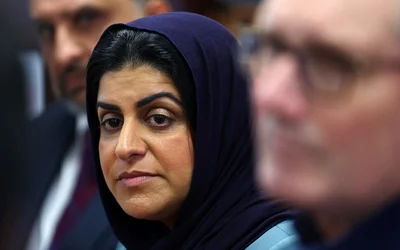
She has been offered a place to study a master’s degree in international health and tropical medicine at the University of Oxford and has also been shortlisted for a scholarship to pursue a doctoral degree at two other UK universities.
She worked as a lecturer at Sudan’s Omdurman Islamic University before she was displaced to Egypt amid the civil war.
The scholarship she has been shortlisted for supports the development of science and technology in low and middle-income countries and requires recipients to return to their home country after completing their degree.
“I have worked diligently for years to reach this academic stage,” she told MEE.
“The news is extremely disappointing. The sudden suspension of student visas for Sudanese nationals could prevent me from pursuing these opportunities despite meeting all academic requirements.”
MEE also spoke to several Sudanese students already studying in the UK who have extended their visas to pursue further postgraduate study.
They said they remain uncertain about how the decision would affect them.
'Collective punishment'
Migrant charities expressed serious concerns about the ban.
Sarker Shams bin Sharif, a spokesperson at the Joint Council for the Welfare of Immigrants NGO, told MEE that he was “deeply worried by the way countries on this list have been targeted”.
“Many of them are experiencing active war, unstable governments or the escalating impacts of the climate crisis, all of which create clear and urgent protection needs,” he said.
Minnie Rahman, CEO of Praxis, a migrant rights charity, raised concerns that the ban may “push more people into risking their lives and taking dangerous journeys”.
“With almost no safe or humanitarian routes available, student visas are often one of the only lawful ways people can reach safety and continue their education,” she said.
She said that blocking Sudanese students amounts to “a form of collective punishment against people simply because of where they come from”.
“It will shut the door on young people trying to rebuild their lives and contribute to society,” she added.
'The decision will affect a whole generation of students in Sudan'
- Dr Abeer Abdoon, Sudanese academic
Robert Yates, a visiting lecturer at the London School of Economics and Political Science and former director of global health at the think tank Chatham House, also raised issues about the policy.
“As the UK cuts aid financing for health, it is vital that we support developing countries in other ways to build and sustain their universal health systems. This will include enabling students to come to the UK to learn about successful universal health reforms,” he said.
“Sudan, Myanmar, Cameroon and Afghanistan are all countries that desperately need to extend health coverage to their entire populations."
“It is therefore very unfortunate that our government’s new visa restrictions inhibit our ability to support these countries build and finance their own welfare states,” he added.
Speaking from Egypt, Abdoon expressed similar concerns.
“The decision will affect a whole generation of students in Sudan,” she said.
“Going to university abroad helps us make changes in our country that we need now more than ever.”
Middle East Eye delivers independent and unrivalled coverage and analysis of the Middle East, North Africa and beyond. To learn more about republishing this content and the associated fees, please fill out this form. More about MEE can be found here.
.jpgef92.webp?itok=7Yh0SfvB)