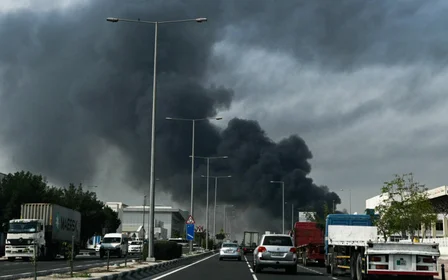

Starmer calls Trump in bid to mend fraught ties over Iran war

British Prime Minister Keir Starmer held a phone call with US President Donald Trump on Sunday in a move widely seen as an attempt to clear the air after tensions over the US-Israeli war on Iran.
According to a Downing Street statement summarising the conversation, Starmer discussed the UK's role in the ongoing war and offered his condolences over the deaths of US soldiers in Iranian attacks on US bases in the Gulf states.
The statement said the pair spoke about "the latest situation in the Middle East and the military cooperation between the UK and US through the use of RAF bases in support of the collective self-defence of partners in the region".
Starmer initially prevented the United States from using a British airbase in the Indian Ocean island of Diego Garcia after the US and Israel began the bombardment of Iran on 28 February.
He has since allowed US military operations for "defensive" reasons, including the targeting of Iranian missile sites involved in attacks against US bases in Arab Gulf states.
New MEE newsletter: Jerusalem Dispatch
Sign up to get the latest insights and analysis on Israel-Palestine, alongside Turkey Unpacked and other MEE newsletters
That concession came after heavy criticism from Trump and pro-war politicians in the UK, including from the Conservative and Reform parties.
Before Sunday's conversation with Starmer, Trump launched a series of invectives against the prime minister over his belated support for the US war.
'We will remember'
Responding to reports that Britain was mulling sending two aircraft carriers to the region to support the US-Israeli campaign to overthrow or subdue Iran's government, Trump claimed the help was no longer needed.
"That’s OK, Prime Minister Starmer, we don’t need them any longer — But we will remember," he wrote on his personal social media platform Truth Social on Saturday.
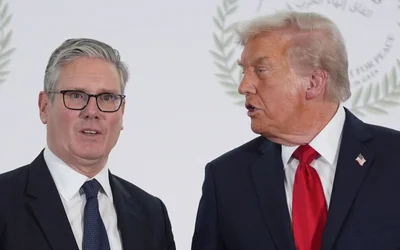
"We don’t need people that join Wars after we’ve already won!"
Earlier, on 3 March, he said he was "not happy with the UK" because it was "uncooperative". Describing Starmer, he said: “This is not Winston Churchill that we’re dealing with.”
Starmer, who before entering politics was a strong critic of the US-led invasion of Iraq, has sought to steer clear of a military entanglement with Iran.
The war, which was initially slated by US officials to last a few days, is reportedly now expected by the Pentagon to go on until at least September.
Washington has acknowledged that at least eight of its personnel have been killed as a result of Iranian retaliatory attacks, and has suffered extensive damage to military installations and equipment dotted around the Gulf area.
The Iranian strategy has focused on inflicting geopolitical, infrastructure and economic damage on the US.
US and Israeli military planners have targeted Iran's civilian and military infrastructure, seeking to snuff out its missile-launching capability and hoping that the attacks will encourage an uprising against the Iranian government.
So far, such a rebellion has yet to materialise, but at least 1,300 people in Iran have been killed in US-Israeli attacks.
Middle East Eye delivers independent and unrivalled coverage and analysis of the Middle East, North Africa and beyond. To learn more about republishing this content and the associated fees, please fill out this form. More about MEE can be found here.
.jpg5ef4.webp?itok=UhM3Jmxw)
.jpgd7df.webp?itok=k3Vg64n3)