
Threats to water supply and food inflation stalk Gulf states

Gulf countries are shutting down oil and gas production as a result of the US-Israeli war on Iran, but it's not just their energy infrastructure that is currently held hostage to Iran’s retaliatory missiles and drones: food and water are, too.
Over 400 water desalination plants line the Persian Gulf. They are used to keep the industry running, keep golf courses green, and, most importantly, quench the thirst of the region's residents.
“It would be absolutely devastating if Iran started attacking those facilities. That infrastructure is a huge vulnerability spread out along the coast,” Mohammed Mahmoud, Middle East lead at the United Nations University Institute for Water, Environment and Health, told Middle East Eye.
Some Gulf countries, like Saudi Arabia, had large volumes of fresh water underground, but it was depleted as their economies transitioned from Bedouin and small trading societies into major global economies and expatriate destinations. Desalination plants started springing up in large numbers in the 1960s and 1970s, and have since mushroomed.
The Gulf accounts for some 60 percent of global water desalination capacity, but the numbers are even starker when states are examined individually. In the UAE, 90 percent of drinking water comes from desalination plants; in Kuwait, it is 90 percent; in Oman, 86 percent; and in Saudi Arabia, 70 percent.
New MEE newsletter: Jerusalem Dispatch
Sign up to get the latest insights and analysis on Israel-Palestine, alongside Turkey Unpacked and other MEE newsletters
One Gulf analyst who works on the intersection of geopolitics and food security in the region told MEE that some have built up strategic stocks, but for small states like Qatar and Bahrain, these could be depleted in days if their desalination plants were destroyed.
“You can't imagine how water-intensive these economies are. Especially as we are entering the spring and summer. They don’t have a plan if those facilities are targeted,” the analyst said, speaking on condition of anonymity.
Gulf industry 'water-intensive'
The US embassy in Saudi Arabia said in a leaked 2008 cable that the kingdom's Jubail desalination plant alone provided Riyadh with over 90 percent of its drinking water. The Gulf has diversified by building more plants over the last 20 years, but it is still just as dependent on those facilities.
'If Iran wanted to bomb those desalination plants they easily could do it, but that would be very escalatory'
- Christian Henderson, Leiden University
The Gulf states’ petrochemical refineries and downstream production facilities also require vast amounts of fresh water.
“The most important part of water usage is for human consumption: drinking water. But that water use is the smallest compared to industrial and agricultural use,” Mahmoud told MEE. “And the Gulf region’s industries are very water-intensive."
The fact that the Gulf’s desalination plants have not been targeted shows that the Islamic Republic is operating with restraint, experts say.
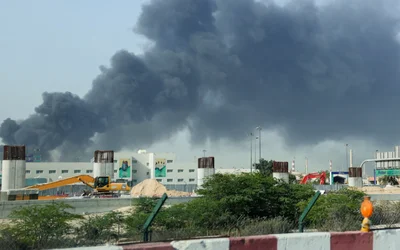
As the war progresses, it is becoming clearer that Iran has used sophisticated targeting to strike US radar installations, diplomatic compounds, and energy infrastructure. Bahrain’s largest oil refinery erupted in flames on Friday after an Iranian strike.
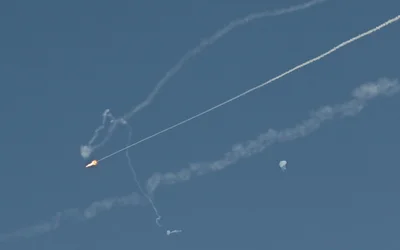
“Right now, Iran’s strategy appears to be striking Gulf energy infrastructure in order to impose economic costs. If Iran wanted to bomb those desalination plants, they could easily do it, but that would be very escalatory,” said Leiden University's Christian Henderson, who is a scholar of political economy and food security in the Middle East.
Talk of the Gulf states joining directly in the US attack has died down in recent days. Their water vulnerability may be one reason why they are reluctant to escalate.
Iran has sent contradictory messages regarding the Strait of Hormuz, the narrow waterway that Bahrain, Kuwait, Qatar, and the UAE rely on for exporting energy and importing goods and foodstuffs.
The reality is that the strait faces a de facto closure with western insurance groups refusing to provide war-risk coverage, leaving all but the most intrepid shipowners transiting it.
The Strait of Hormuz’s closure, along with severely disrupted air travel, means the Gulf is also vulnerable to food shortages.
“Upwards of 80 to 90 percent of some Gulf states’ food is imported. Their entire economic model is based on imports. The closure of shipping lanes and ports is going to disrupt that,” Henderson said.
Economic model disrupted
“The governments are working to prevent this, but inevitably there will be panic buying,” he said. “Having said that, Gulf countries, and certainly the UAE, have prepared and stockpiled basic commodities for I’d say up to three to six months,” Henderson said.
The Gulf countries rely on air transportation for much of their food imports. Some commentators note that Gulf states have developed strong agricultural sectors. For example, the UAE and Saudi Arabia are major regional dairy hubs. But their cows are dependent on imported feedstocks. The UAE is a big consumer of alfalfa from Arizona.
Even as the UAE moves to reopen Dubai International Airport, other regional airspaces remain closed, and cargo flights could be disrupted, experts say.
The Strait of Hormuz’s closure means foodstuffs will have to enter Bahrain, the UAE, and Qatar via ports of entry in Saudi Arabia and Oman that have been less impacted.
“Increased shipping and insurance costs will all manifest themselves in food inflation. There will need to be a substantial reorganisation if they reroute everything through Sohar and Jeddah ports,” Henderson said, referring to Omani and Saudi Arabian ports, respectively.
Some Gulf countries, especially the UAE, have also emerged as key transhipment and food processing hubs for Asia and Africa. Even if Iran doesn't target them specifically, the war could upend their business models.
For example, Dubai-based Al Khaleej Sugar owns the world's largest port-based sugar refinery. It imports 1.6 million metric tons of raw sugar annually and exports around 1.3 million tons of refined sugar annually.
Al Khaleej Sugar told Reuters on Thursday that it was open and operating normally and has two years' worth of raw stock.
Middle East Eye delivers independent and unrivalled coverage and analysis of the Middle East, North Africa and beyond. To learn more about republishing this content and the associated fees, please fill out this form. More about MEE can be found here.