

Gaza hit by food shortages and price hikes after Israel shuts crossings

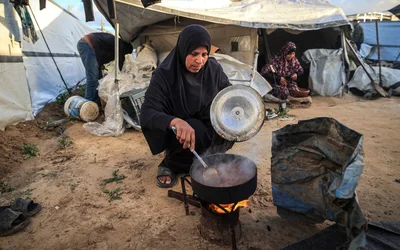
As the US-Israel war on Iran began last week and Gaza’s crossings were shut, panic spread through the densely populated enclave, raising fears of a famine returning.
Palestinians rushed to markets to stock up on essentials, as soaring prices and shortages of key items, particularly vegetables, signalled the impact of the closures.
Gaza depends almost entirely on border crossings for the entry of food and essential goods, meaning any sudden closure is quickly reflected in local markets and household budgets.
For Ibrahim Madoukh, a father of eight from al-Sahaba neighbourhood in Gaza City, the price surge has already begun to affect his family’s fragile livelihood.
Since the October ceasefire, Madoukh has been selling falafel from a small stall to support his family. Demand had been steady, he said, largely because he kept his prices low.
New MEE newsletter: Jerusalem Dispatch
Sign up to get the latest insights and analysis on Israel-Palestine, alongside Turkey Unpacked and other MEE newsletters
But rising ingredient costs have forced him to increase prices, while customers - many already struggling financially - are buying less.
“The economic situation in Gaza has been deteriorating since the war,” Madoukh said. “Many people can no longer afford what is available in the market.”
After hearing about the crossing closures, Madoukh rushed to buy supplies before they disappeared. Instead, he found markets crowded with residents trying to do the same.
'Why must Gaza pay the price for wars it’s not involved in?'
- Ahmed al-Shoubaki, Gaza resident
The price increases were immediate and dramatic. A kilogram of onions that once cost three shekels (around $1) now sells for 15 shekels (around $5). Cooking oil has jumped from 5 shekels (around $1.5) to 13 (around$4), while the price of parsley has risen eightfold.
“Traders say prices are rising because the crossings are closed and supplies are running out,” he said.
Madoukh has already been forced to raise the price of his falafel from two pieces for 1 shekel to one piece for 2 shekels.
Even so, many families still cannot afford it.
“Before the crossings closed, displaced children sometimes came to my stall asking for falafel because they were hungry and had no money,” he said. “I used to give it to them, but now I can’t. I’m already losing money.”
Madoukh fears he may soon have to shut down his stall entirely if prices continue to rise or ingredients disappear from the markets.
“I only have enough supplies for one week,” he said. “If the situation continues like this, we may face the same hunger we experienced before.”
‘Our lives are already hell’
Israel closed all crossings into Gaza on Saturday, halting the movement of people, aid and goods, shortly after the war with Iran began.
The Karem Abu Salem crossing with Israel was partially reopened on Tuesday, allowing limited entry of fuel and humanitarian aid, while other crossings, such as the Rafah border with Egypt, remain shut.
The UN has called for more crossings to reopen to scale up humanitarian support, particularly as many NGOs in the Strip face restrictions.
Metres from Madoukh’s falafel stall, Ahmed al-Shoubaki, 39, was stocking up on supplies for his family. Carrying a large bag filled with tins, tahini, ghee, spices and olive oil, he carefully asked a vendor about the price of sugar.
“Since the crossings closed on Saturday, I’ve been going to the market every day to buy whatever I can and store it at home,” Shoubaki told Middle East Eye.
“My wife and I agreed to keep the staples like flour, cooking oil, and canned goods untouched, buying only daily necessities from the market while they last.”
Before the Israeli genocide in Gaza, Shoubaki worked as a painter, but shortages of materials forced him to switch careers. He opened a small food stall selling kebab and grilled chicken, which he had to close last month due to declining sales.
His story mirrors the experience of thousands of Palestinians in Gaza who have lost their livelihoods as entire sectors have ceased operating.
“The economic situation in Gaza has collapsed. There is no work, so no one can cope with rising prices,” he said.
“When I heard about the [Iran] war, I spent more than $1,000 - almost all my savings - buying supplies to last a month. I don’t know how I’ll manage later, but I had to do it. My children cried from hunger last Ramadan; I can’t let that happen again.”
Shoubaki condemned the suffering imposed on Gaza, which he says has no role in the Iran-Israel conflict.
“Why must Gaza pay the price for wars it’s not involved in? Our lives are already hell from siege, destruction, and hunger.
“Death would be more merciful than living through this continuous suffering. I fear the crossings will remain closed for a long time, and our suffering will only continue.”
Vulnerable families suffer
Despite crowds rushing to stockpile food, most residents of Gaza can buy only enough for a single day as prices soar and purchasing power plummets.
Rana Rajab, 38, a mother of six, fears that the closure of Gaza’s crossings could bring famine back, yet her family cannot afford more than daily supplies.
Her husband works as a mechanic on a daily wage, meaning income - and access to food - varies from day to day.
“Since the ceasefire began, we have been suffering from poverty and hunger,” Rajab told MEE.
“On the days my husband works, we buy food. On the days he doesn’t, we rely on charity kitchens or whatever aid we can find.”
Rising prices have worsened the situation.
'Every time we go through famine, it’s worse than before'
- Rana Rajab, Gaza resident
“Many goods, especially vegetables, have doubled in price,” she said.
“I have six daughters. Last year during the famine, my youngest, Haya, who is five, contracted hepatitis and was hospitalised for several days.”
Rajab has already started cutting both the number and size of her family’s meals in anticipation of further shortages.
“Before the war on Gaza, during Ramadan, we ate chicken fish, or meat every day. I cooked different dishes, sometimes even two types in a single day, and shared food with relatives and neighbours,” she said.
“Now we can barely afford meals for ourselves.”
She described her shock at recent market prices.
“Yesterday, chicken cost 46 shekels per kilo - more than double the usual 20. I could not buy it, so we ate the lentils I had stored, even though my children dislike them because it reminds them of last year’s famine.”
Rajab fears each crisis hits harder than the last.
“Every time we go through famine, it’s worse than before,” she said.
“We hope the United Nations and international powers pressure Israel to allow commercial goods and aid into Gaza.
“We are not responsible for the wars between Israel and anyone else, yet we bear the cost.”
Middle East Eye delivers independent and unrivalled coverage and analysis of the Middle East, North Africa and beyond. To learn more about republishing this content and the associated fees, please fill out this form. More about MEE can be found here.
.jpg549e.webp?itok=lsgGHIaR)
%20(1).jpgeff7.webp?itok=gAC9dpYM)
.jpg7f88.webp?itok=oE0sDFAb)